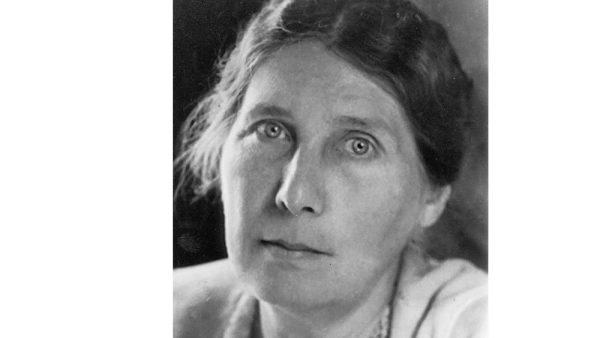
A series of lectures to celebrate Ita Wegman’s 150th birthday
‘I am for striding forwards’
Ita Wegman¹
To mark the birthday of Ita Wegman, the General Anthroposophical Section at the Goetheanum is commemorating 150 years since the birth of Ita Wegman with a series of online lectures taking place throughout 2026, offered in English with Spanish translation, for the worldwide anthroposophical movement. This is a complementary offer to the conference Courage to Heal taking place at the Goetheanum from 20-22 February 2026.
Key milestones in her life
Over the course of six lectures, Peter Selg will present key milestones in the life of Ita Wegman: her collaborations with others, her contributions to medicine, social development, and inclusion, as well as her ongoing resistance and courage in the face of challenges.
Registration for the lectures is donation-based. A recording is provided to all participants, allowing you to register and view the lecture at a later time if you are unable to attend live.
The registration for the next session on 5 April will open soon.
Wegman studied medicine at Rudolf Steiner‘s suggestion only when she was already over thirty years old. As early as 1921, she founded the world’s first and, until the 1960s, only anthroposophical clinic in Arlesheim (Switzerland). Today it is named after her, just like the classical rhythmic massage according to Ita Wegman, which was developed into an independent form of therapy in anthroposophical medicine.
Wegman developed a remedy for cancer from mistletoe, with Rudolf Steiner’s help, and later called Iscador, as well as special forms of care, special rubs and wraps and classical rhythmic massage.
Wegman also became co-founder and head of the Medical Section of the School of Spiritual Science at the Goetheanum in Dornach. In this capacity she initiated and accompanied the founding of numerous medical and curative education institutions worldwide.
She also cared for Rudolf Steiner in the last months of his life and until his death.²
Find out more about Ita Wegman
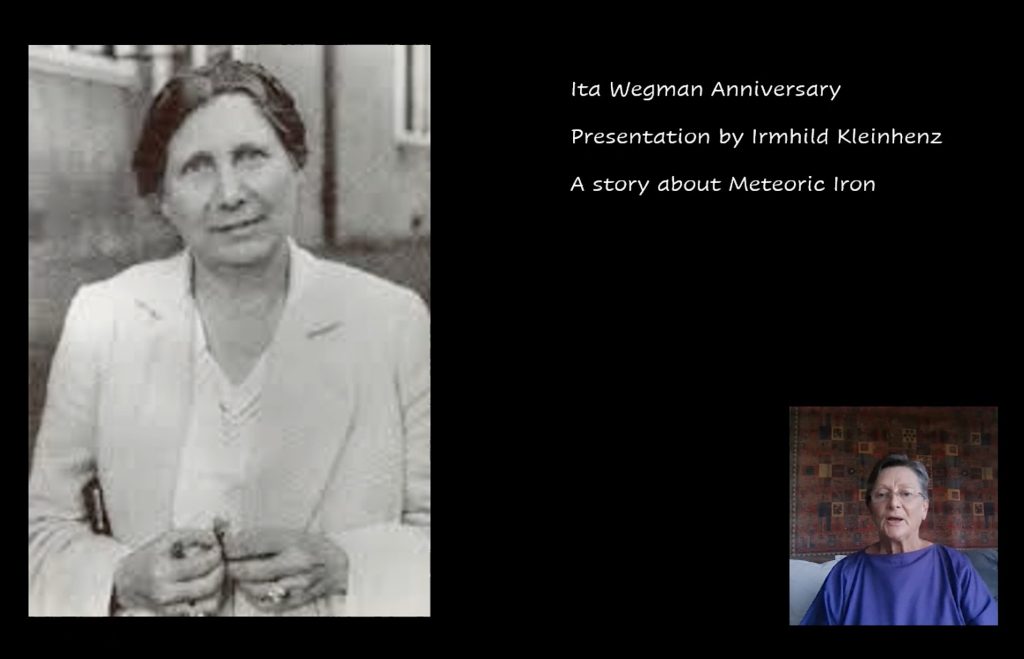
Watch a short video on Ita Wegman’s influence and meteoric iron’s role in medicine.
Spiritual courage
‘From 1933 to 1935, Ita Wegman was confronted by both Nazi fascism and internal crises in the General Anthroposophical Society. She had unambiguous perspectives and a uniquely clear view of both the political threat and her social-spiritual task during this period”.
“There was, however, a radical change in her inner stance toward the opposition, aggression, and defamation she encountered within anthroposophic contexts in reaction to her intense, purely motivated efforts. She tried to live and work in true accord with her inner impulses and, ultimately, with Rudolf Steiner’s legacy, especially within the anthroposophic movement. Doing so, she increasingly found her way to her own distinctive and uncompromising path”‘³
Social commitment
During this extremely troubled period, Wegman was greatly concerned with the complex processes of community building amongst the doctors and medical students. In a letter she wrote at this time, she asks4:
What really binds a community together?
A community is, of course, always held together by a certain impulse of will. Moreover, in a community that seeks to dedicate itself to healing, the will to heal must naturally take the lead, but one that also includes and encompasses Rudolf Steiner. This will to heal must be conceived comprehensively so that at the same time you advance with it toward the real nature of the human being. To become a true human being, led by Rudolf Steiner, is after all what binds us together in our community. To reach this authentic humanity sometimes involves the most difficult trials, and certainly one does not accomplish it without suffering deep inner pain. One can be sure that a community that sets itself such a lofty goal will pass through tempests. It is not easy to stay upright through them, for nothing in the present world will endure. The world situation is uncertain and people’s place in it equally so. The future is uncertain; there is nothing that can easily sustain us. We are really thrown back on ourselves entirely. (p. 68)
And then states:
In a spiritual movement that sets itself high goals, the number of people involved is not the critical thing but instead the quality they bring to it. (p.69)
‘If we are cowardly in any way, we do not live with the world, we exclude ourselves; we only appear to breathe.’
Rudolf Steiner
Feature image: Ita Wegman aged 52 in Breslau, 1928, courtesy of WALA Heilmittel GmbH’s historical company archive.
¹ Source: Medizinische Sektion am Goetheanum, The Courage to Heal Conference,
² Source: AnthroWiki, Ita Wegman.
³. Source: Rudolf Steiner Book Centre website, Spiritual Resistance Ita Wegman, 1933-1935 by Peter Selg
4. Source: :Spiritual Resistance Ita Wegman, 1933-1935 by Peter Selg